#USA #DC – The president of the U.S. Conference of Catholic Bishops condemned the Department of War’s plan to livestream the scheduled firing-squad execution of Nidal Hasan as “a barbaric promotion of a culture of death,” with other bishops and the Archdiocese for the Military Services also speaking out against the proposal.
Archbishop Paul S. Coakley of Oklahoma City, who leads the USCCB, issued the statement on October 9, 2026, after officials announced that the execution would be carried out publicly at Fort Hood, Texas, on December 3. Hasan, a former Army major and psychiatrist, was convicted in 2013 of killing 13 people and wounding 32 others in the November 5, 2009, attack at the base. Witnesses reported that he shouted “Allahu Akbar” before opening fire on soldiers preparing for deployment; he later described the shooting as motivated by a desire to protect Taliban fighters.
“It is with shock and great sorrow that I have learned of the Department of War’s decision to publicly livestream the execution of Nidal Hasan,” Coakley said. “Our God is the God of life. In no way can Hasan’s actions be condoned but this decision is a barbaric promotion of a culture of death and must be reconsidered. The word of God exhorts us: ‘do not repay anyone evil for evil’ (Romans 12:17). The public execution even of one who has done grave harm will only further undermine the moral fabric of our nation and be a blight on the conscience of its people.” He concluded by praying for the intercession of Our Lady of Good Counsel “that we as a nation may always choose life even in the most trying times and circumstances.”
The plan followed President Donald Trump’s approval of a firing-squad execution recommended by Defense Secretary Pete Hegseth. Hegseth had stated that the execution would be public so that “people need to understand that there are serious consequences for these types of things.” It would have marked the first U.S. military execution since 1961 and the first by firing squad since World War II, as well as the first widely livestreamed execution in the modern United States.
Other Catholic leaders echoed the criticism. Archbishop Timothy Broglio of the Archdiocese for the Military Services, USA, reaffirmed the Church’s opposition to capital punishment in a statement to EWTN News. “Catholic teaching about the death penalty is clear,” Broglio said. “Already the Catechism of the Catholic Church, even before its revision by the late Pope Francis, indicated that in a country such as the United States where the means exist to protect society from such criminals, the death penalty was inadmissible.” He noted that the teaching had become “even clearer and more universal,” citing the Catechism’s declaration that the death penalty is “inadmissible because it is an attack on the inviolability and dignity of the person,” and added that “even in the case of the most heinous crimes, the Church begs for clemency.”
Bishop Michael F. Burbidge of the Diocese of Arlington also issued a statement joining Coakley and “my brother bishops in expressing my shock at the Department of War’s plan to livestream a public execution.” Burbidge described Hasan’s actions as “barbaric” and noted that he “was justly found guilty of the murder of 14 unarmed men and women, including a mother and her unborn child.” He wrote that the Church “proclaims the dignity of all persons and, accordingly, emphasizes the profound responsibility of civil authorities to encourage conversion of heart and a spirit of repentance,” and that “capital punishment, at a minimum, in instances where nations and states still lamentably practice it, should never be made into an occasion for public spectacle.”
The Catholic Church’s current teaching, revised in the Catechism in 2018 under Pope Francis, holds that the death penalty is inadmissible as an attack on human dignity and that the Church works for its abolition worldwide. Earlier formulations had treated it as theoretically permissible only in rare cases of absolute necessity to protect society, but modern detention capabilities made such cases “very rare, if not practically non-existent.”
The announcements drew broader criticism as well. Catholic Mobilizing Network, which works with the USCCB on death-penalty issues, condemned both the execution and the livestream plan. Its executive director, Krisanne Vaillancourt Murphy, called the proposed broadcast “appalling” and “a grotesque display of hatred,” arguing that it would neither honor victims nor bring healing and that “we undermine our own humanity when we treat another person’s death as something to watch, celebrate, or use for entertainment.”
Vatican Secretary of State Cardinal Pietro Parolin also commented that turning death into a spectacle was “unacceptable,” reiterating the Church’s total opposition to the death penalty as incompatible with human dignity and not serving as a deterrent. Some U.S. lawmakers from both parties likewise criticized the public nature of the planned execution, with concerns raised about its potential impact on the nation’s moral fabric, compliance with military regulations regarding witnesses, and the absence of modern precedent for livestreaming an execution.
The Trump administration has held conflict with U.S. Catholic leaders and the Vatican State since 2025 when U.S. bishops opposed inhumane treatment of illegal immigrants in detention centres and mass deportations. In January 2026, Pope Leo XIV condemned the Trump administration for its foreign policy, asserting that the U.S. was shifting from peaceful diplomatic practice to gunboat diplomacy. As a result of this speech, the Pentagon summoned the Vatican ambassador to the United States in what became a tense meeting.
In late February 2026, the U.S. and Israel attacked Iran, resulting in extremely vocal condemnation from Pope Leo XIV, especially towards Christian U.S. government officials. As a result, President Trump fired back at Pope Leo on social media. Although the Iran War conflict has remained ongoing, since May 2025 when tensions between the U.S. and Iran have de-escalated, so has Catholic leader’s criticism of the conflict shifting focus back towards the Trump administrations immigration policies, among other issues.
Aside from attempting to intimidate the Vatican ambassador to the United States, the Pentagon has also been criticized for alleged discrimination towards Catholics and favortism towards Protestant groups when it hosted an Good Friday service at the Pentagon, but no Catholic Holy Mass. Secretary of War Pete Hegseth has also been criticized for using Christian beliefs to form a Christian fundamentalism within his department, which became outed in the early days of the Iran War when U.S. service members made complaints about the sort of religious rhetoric and language that came from their senior officials. Hegseth has been also well-known to make such fundamentalist comments, especially as it relates to the U.S.’ relationship to Israel. Most recently, Hegseth had empowered chaplains as rumors circulate about U.S. escalating its action in Iran after the midterm elections.
Regardless, the U.S. bishops condemnation across the country of the first public execution by firing squad to be livestreamed will likely renew tensions between the Pentagon and U.S. Catholic leaders, and the Roman Church’s position on the war and Trump policies are likely to remain unchanged as they continue to conflict with Catholic teachings related to respect for life and human dignity.
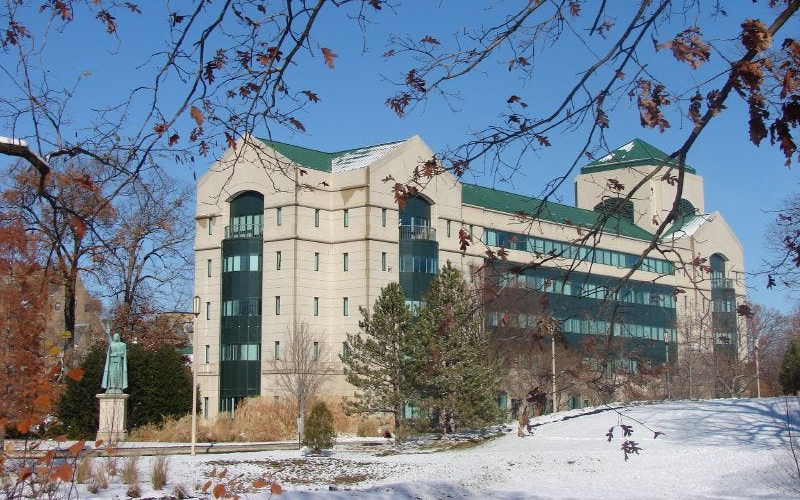
Cover Image: USCCB office building in Washington D.C.