#UK #Scotland #Glasgow – The Roman Catholic Archdiocese of Glasgow announced in early October 2026 that it would reduce the number of its parishes by roughly half, cutting them from around 80 to about 40, and close 24 churches over the next five to ten years.
Archbishop William Nolan detailed the restructuring in a letter to congregations, stating that the changes responded to a sharp decline in priests and religious practice. “There are too many parishes but too few people, too many churches but too few priests,” he wrote. “Compared to when these parishes were formed and our churches built, there are significantly fewer people coming to Mass. Some of our largest churches are in places where there are the fewest people.”
Nolan noted that active priests had fallen by a third in the less than five years since he became archbishop in 2022. Only one priest was under age 45, while most were over 60. Archdiocesan officials projected that as few as eight active priests could remain in 20 years to serve a Catholic population of about 200,000. Foreign priests, numbering around 20 and mostly from Nigeria and other countries on temporary visas, had helped fill gaps, but officials said such support could not be relied upon indefinitely. Immigration rules had also made it harder to bring in overseas clergy, and religious orders faced their own shortages.
The proposals covered parishes in Glasgow and Dunbartonshire. They called for a series of mergers, with many parishes expected to share buildings before some churches closed. Most reductions were targeted within five years, with others over five to ten years. The plan had been approved in principle by the archbishop and the Council of Priests after years of discussion and local consultations. Each merger or closure was to proceed individually under canon law rather than through a single mass shutdown.
Nolan acknowledged the emotional impact. “Our parishes and our churches hold great memories for us and are dear to our hearts, so any reduction in parishes and any closure of churches will be a painful experience,” he wrote. “We cannot avoid that pain, though, by not facing up to reality.” He compared the process to pruning a vine so that it might grow stronger.
The announcement came against a backdrop of broader secularization in Scotland. The 2022 census showed that a majority of people in Scotland reported no religion, and the number of people identifying as Catholic had declined by more than 117,000 nationwide over the previous decade. Local reaction was mixed, with some describing the changes as sad but necessary to preserve viable ministry and maintain aging buildings. Details of affected parishes appeared in the archdiocesan newspaper Flourish and in local reporting.
Officials said the restructuring aimed to create a more sustainable structure rather than simply managing decline. According to a 2023 Times report, Archdiocese income fell from about £26.5 million in 2018 to £10.8 million in 2021. That year it ran a deficit of nearly £1 million (spending more than it took in). Glasgow was one of three Scottish dioceses operating at a deficit at the time. Church leaders described a “perfect storm” of falling attendance, the cost-of-living crisis, rising expenses, and pandemic effects (churches faced tighter restrictions than many businesses).
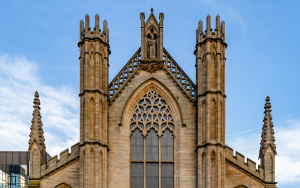
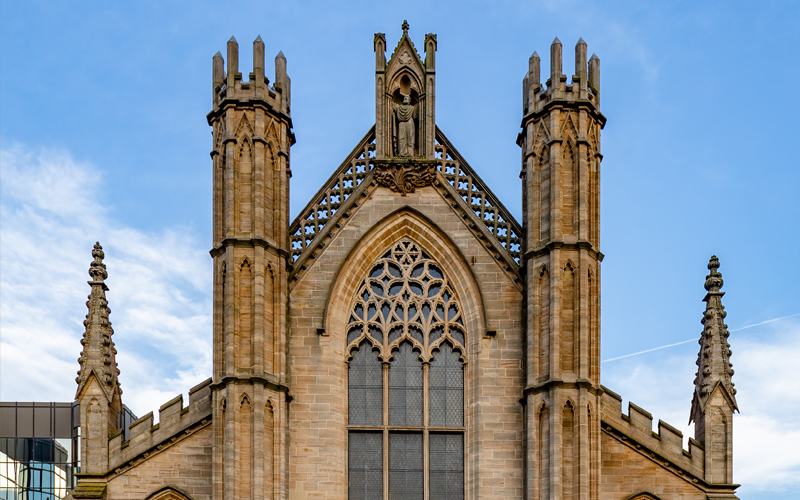
Cover Image: St. Andrew’s Cathedral, the seat of the Archbishop of Glasgow dedicated to the patron saint of Scotland.