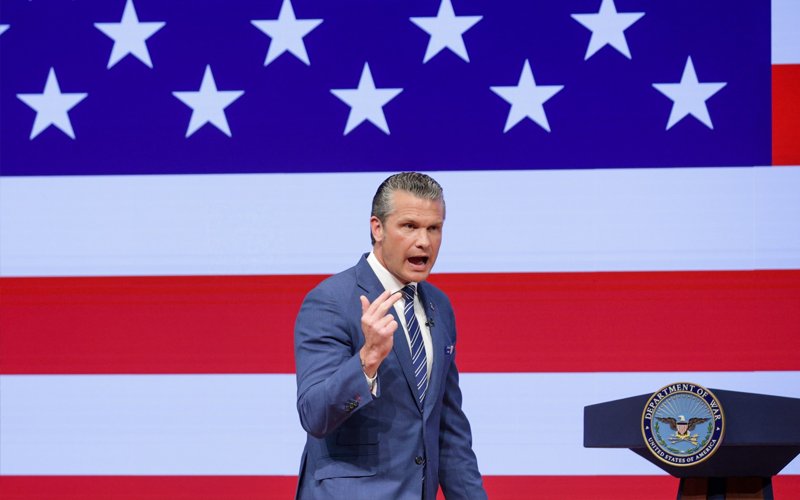
#USA #DC – The Pentagon established a new Office of Religious Affairs on September 30th, 2026, and described spiritual readiness as a core element of military combat effectiveness. These changes come amid rumors that U.S. President Donald Trump would authorize to deploy troops to land in Iran after the midterm election in an escalation of the Iran War, which began in February 2026.
War Secretary Pete Hegseth announced the office during a “State of the Force” address at Marine Corps Base Quantico, Virginia, and formalized it the same day in a memorandum to senior leaders, combatant commanders, and defense agency directors. The memo said the office was created “to strengthen the moral, ethical and spiritual readiness of our warfighters.” Its director was designated a principal staff assistant with direct access to the secretary and deputy secretary, and was named the department’s principal advisor on religious affairs.
Department statements said the office would elevate spiritual readiness alongside other measures of force effectiveness. Officials said wars are fought by people, and that the strength of the force depends not only on weapons, training, and technology, but also on the resilience, conviction, and moral strength of those who serve. The office was charged with driving department-wide policy, advocating for resources, and identifying unmet requirements so that service chaplaincies could operate with fewer bureaucratic barriers.
In the Quantico speech, Hegseth used explicitly religious language as he has done so before. He said the department was “putting on the full armor of God,” added that “while we wage physical war, we all know the real battle is spiritual,” and stated that “God is good. Evil is not. And America’s military must understand the difference.” He linked the move to the Continental Army’s chaplains, established in 1775, and to the national motto. He told chaplains to live their calling and said the new office would give them an advocate at the highest level, with authority to protect budgets and demand infrastructure rather than function as a paperwork shop.
The memorandum assigned the office several concrete tasks. It was to ensure funding and resources for the delivery of religious ministry, facilities and infrastructure, logistics, chaplain procurement and training, chaplain-led programs, chapel youth programs, faith-based homeschool support for military families, and faith-based initiatives tied to suicide reduction and force resilience. It was also directed to sponsor research and analytical tools to assess spiritual fitness, spiritual readiness, and spiritual resilience. The Armed Forces Chaplains Board was to be realigned under the office. Service secretaries and chiefs of chaplains were ordered to submit, within 90 days, a baseline report of unfunded and underfunded religious-affairs requirements. Budget officials were directed to work with the office on an initial baseline and a funding plan.
Both the memo and department statements said the office would not compel religious participation, favor one faith, or diminish the rights of personnel of any faith or of none. They said the military departments’ chaplaincies, established under federal law, would remain the primary providers of religious support, and that the new office’s role was to prioritize free exercise and spiritual readiness across the total force.
No director was named at the time of the announcement. The move followed other faith-related steps under Hegseth, including changes to the chaplain corps and a reduction in the number of religious affiliations the department formally recognized. Coverage by the Associated Press, Military Times, and the department’s own releases confirmed the establishment of the office and the language used to describe it.
The Pentagon had previously received complaints from service members when the Iran War started that senior personnel were using Christian fundamentalist rhetoric to attempt to motivate troops. Likewise, Hegseth has been known to use the same sort of rhetoric. Critics have suggested that the new office may be used to psychologically prepare service members for deployment in Iran, especially among extremely low popularity of the war, especially among service members.
Cover Image: Secretary of War Peter Hegseth addressing troops at Quantico, Virginia.