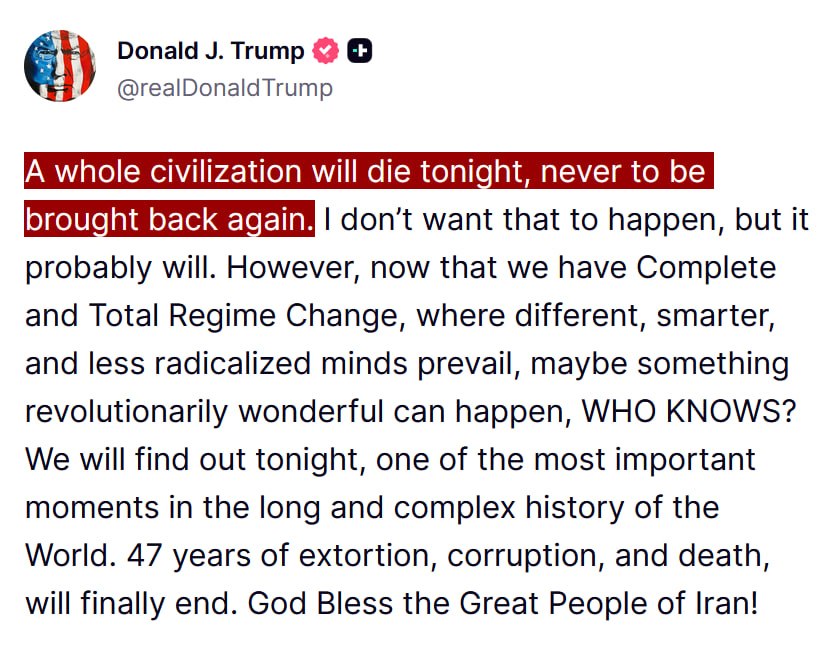
#USA – On April 7th, 2026, President Trump posted on his Truth social media that “a whole civilization will die tonight, never to be brought back again. I don’t want that to happen, but it probably will.” He tied it to a deadline (8 p.m. EST) for Iran to agree to a deal reopening the Strait of Hormuz, through which about a fifth of the world’s oil passes. He also threatened to destroy Iran’s power plants, bridges, and other infrastructure. This social media post is the latest in a series of threatening posts that have been made since the Easter weekend, which has received strong criticism, especially from Christian leaders, due to their vulgar nature and inconsideration for the dignity of human life. Numerous international law experts, human rights organizations, and legal analysts described some of these posts as expressing intent to commit actions that would constitute war crimes under international humanitarian law.
In preceding days and a press conference, Trump explicitly threatened targeting every bridge and every power plant in Iran, describing them as being “decimated,” “burning, exploding, and never to be used again.” Broader destruction, including possibly desalination plants and other infrastructure, with comments like Iran being “taken out in one night” or “bombed back to the Stone Age.” Under the Geneva Conventions and broader international law, deliberate or indiscriminate attacks on civilian infrastructure (i.e. power plants, bridges, desalination facilities serving civilian populations) without strict military necessity, or when disproportionate harm to civilians is expected, are prohibited. Additionally, collective punishment of civilians and threats aimed at terrorizing the civilian population are banned, and destroying objects indispensable to civilian survival (i.e. power for hospitals/water systems) can qualify as a war crime.
The most vulgar of these threats were made on Easter Sunday, the most holy and special day in the Christian calendar, in which Trump stated the following on Truth social media:
“Tuesday will be Power Plant Day, and Bridge Day, all wrapped up in one, in Iran. There will be nothing like it!!! Open the Fuckin’ Strait, you crazy bastards, or you’ll be living in Hell – JUST WATCH! Praise be to Allah. President DONALD J. TRUMP”
The social media messaged received intense criticism from people on social media, as well as Democrats and Republicans that have opposed the war. The message was considered an affront to Christians attempting to celebrate a day of peace and sanctity, and the mockery of “Praise be to Allah” a blurring of the political-religious dynamic in what has been criticized since the start of the war to be a religious war rather than political one, with religious fundamentalism being exposed in both Israel and the United States in opposition to the Islamic regime in Iran.
In response to the latest post on April 7th, 2026, speculation on President Trump’s willingness to use nuclear weapons resulted in a White House response later the same day that the administration was not considering the use of nuclear weapons to achieve its aims. Nonetheless, Christian leaders responded to the sensitive and serious situation that had begun to unfold. The President of the United States Conference of Bishops, and Archbishop of Oklahoma City, Paul Coakley, called “on President Trump to step back from the precipice of war and negotiate a just settlement for the sake of peace and before more lives are lost.” In response to Pope Leo XIV call for peace this Eastertide, the archbishop encouraged the faithful to join in the Pope’s prayer vigil on Saturday, April 11th.
Pope Leo XIV also responded to Trump’s comments from Tuesday morning, stating “today, as we all know, there was this threat against the entire people of Iran, and this is truly unacceptable. There are certainly issues of international law here, but even more so a moral issue for the good of the whole, entire population.” He explicitly referenced attacks on civilian infrastructure as violations of international law and urged “all people of goodwill” — including Americans — to contact their political leaders and congressional representatives to “reject war” and push for peace, especially in what he described as an escalating, unjust conflict that resolves nothing. Pope Leo has been openly opposed to the Iran War since it began in late February, but these comments have been the strongest rebuke of the war
Catholic leaders have been particularly vocal, framing the threats through just war criteria (proportionality, discrimination between civilians/military targets, etc.) and moral teachings against targeting civilians. Responses have emphasized peace, dialogue, and alternatives to escalation. Some individual Catholics and conservative evangelicals have pushed back or supported the administration, but institutional Catholic voices and mainline Protestants have largely aligned with calls for restraint.
Rev. Jacqueline Lewis (senior pastor, Middle Church in Manhattan) described the comments as a “war crime” and “intent to commit genocide,” shocking her congregation. Rev. Dr. Robert P. Jones highlighted that such actions violate both international law and core Christian just war tradition. The World Council of Churches (representing Protestant, Orthodox, and other traditions) expressed “grave concern” over threats to attack civilian infrastructure. Some Anglican figures, such as the Iranian-born Bishop Guli Francis-Dehqani of Chelmsford, have denounced the war as “unjust and illegal.”
Although in essence the Iran War is not a religious war, but a political conflict between the United States and Israel versus the Islamic Republic of Iran, the calls for an end to violence have provoked strong moral opposition among individual faithful Christians, but also non-Christians and non-religious persons as the conflict has been one of the most unpopular conflicts the United States has been involved in, and resulted in a drastic plunge in the U.S. President’s popularity. Nonetheless, in a time of uncertainty in the course of this regional conflict, the opposition voices from spiritual leaders has provided comfort and validation to the supermajority of everyday people for the lack of justification and moral reasoning behind this war that has caused death of innocents across the region, especially Iran, Lebanon, and Israel, and will have a global economic impact that will last for the year to come, even if the war were to end tonight.
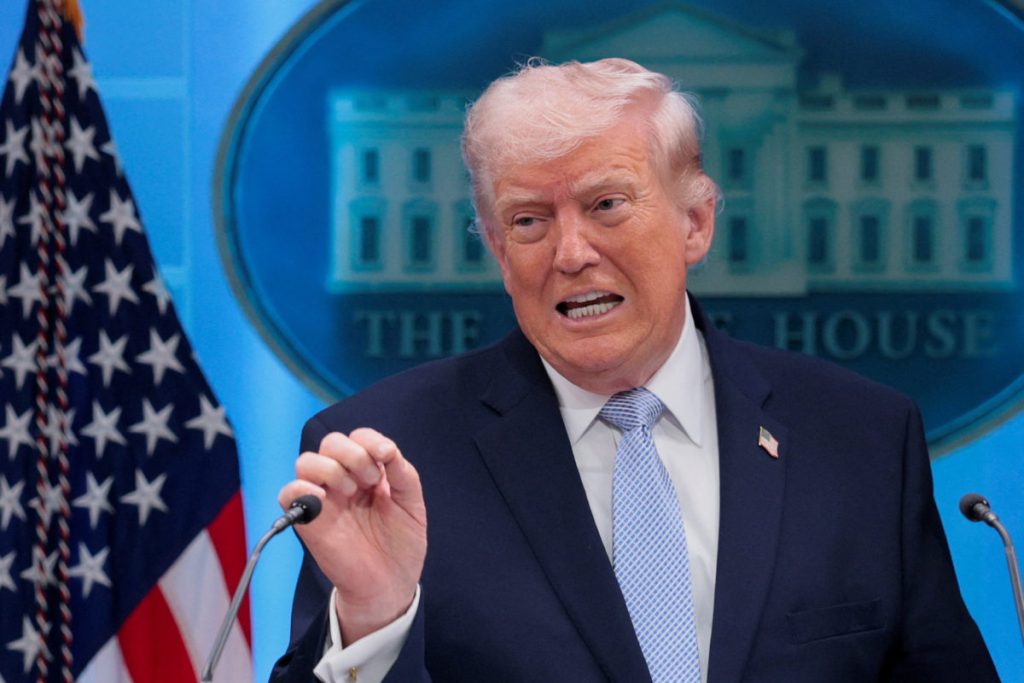
Image: U.S. President Donald Trump at a press conference on April 6th, 2026.