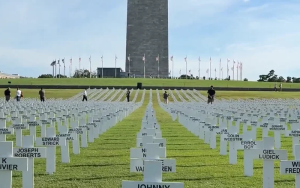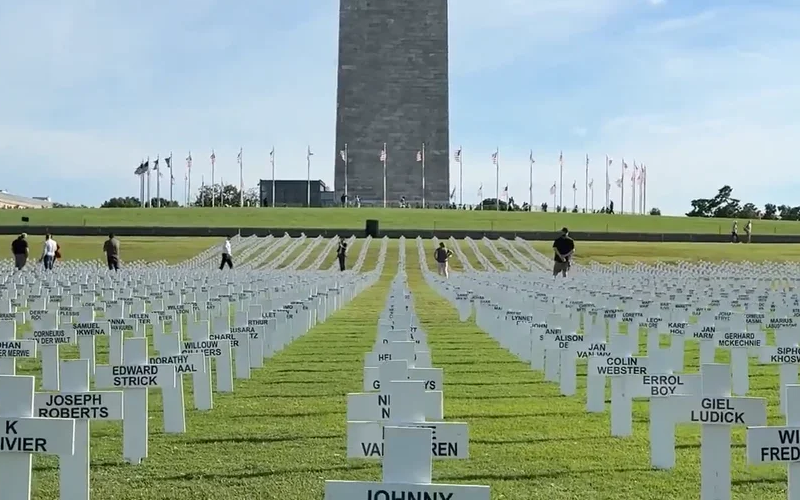
#USA #DC – On Saturday, organizers planted roughly 3,000 named white crosses on the National Mall near the Washington Monument, turning a stretch of lawn into a temporary memorial for those killed in farm attacks in South Africa, almost ninety-percent of whom identify as Christians.
Volunteers marked the grass in rows and drove the crosses into the ground with rubber mallets. Each marker carried a name. Lex Libertas, a Pretoria-based group led by Ernst Roets, staged the display with the New York Young Republican Club after a conference Friday at the National Press Club. Organizers said the crosses represented victims of farm murders since the early 1990s and were meant to force an international audience to confront violence that, in their telling, has repeatedly fallen on rural Christian families.
The Christian identity was central to how they presented the dead. Afrikaners are overwhelmingly Christian. Mission and demographic profiles have long estimated that about 89 percent identify as Christian, chiefly in Protestant and Reformed traditions that grew out of Dutch, Huguenot, and later Pentecostal churches. Census figures for white South Africans, of whom Afrikaners form the largest Afrikaans-speaking share, have put Christian affiliation even higher in recent counts, between 87 up to 90 percent, with the Dutch Reformed Church historically the largest single denomination. Organizers used the traditional Christian Latin cross itself as a public sign of that inheritance: farming households bound to church, Scripture, and a rural way of life they said had been met with night raids, torture, and murder.
The site sat north of the monument, within view of the White House and beside Constitutional Avenue and the National Museum of African American History and Culture. From that vantage, the field of crosses formed a stark Christian symbol in the center of the capital. Organizers described the project as more than commemoration. They said it was a public witness for murdered farmers and their relatives, many of them Afrikaner Protestants whose churches, homesteads, and isolated livelihoods had been shattered.
Relatives took part. Heidie Taljaard placed crosses for her father, mother, and sister. Other farm-attack survivors, including Amanda Platt, were scheduled to speak and stand with the memorial. Organizers presented those testimonies as evidence that the violence was not abstract: families attacked in their homes, often far from rapid police help, in assaults marked by extreme brutality.
President Trump’s Marine One helicopter flew over the display Saturday morning, an image that organizers and supporters quickly circulated as a sign that the memorial had reached the highest levels of American politics. The Trump administration had earlier attempted to address the mass violence to the South African government during a state visit in 2025, but no further action or addresses have been made other than that spectacle in the White House.
The crosses were permitted only for the day and were due to come down by late afternoon. Even so, the demonstration was designed to linger. Roets and his partners tied the vigil to a broader campaign for U.S. attention to farm murders, race-based policy in South Africa, and what they called threats to minority communities, including calls for greater self-governance.
South Africa’s ambassador to the United States, Roelf Meyer, called the “political persecution” narrative dangerous and unproven, arguing that farm killings sit inside the country’s wider crime crisis rather than a proven campaign against one faith or people. Another Afrikaner group, Afrikaners for SA, accused Lex Libertas of turning victims into political props and warned that the display would give Americans a distorted picture of the country.
Cover Image: The crosses seen before the Washington Monument in D.C.