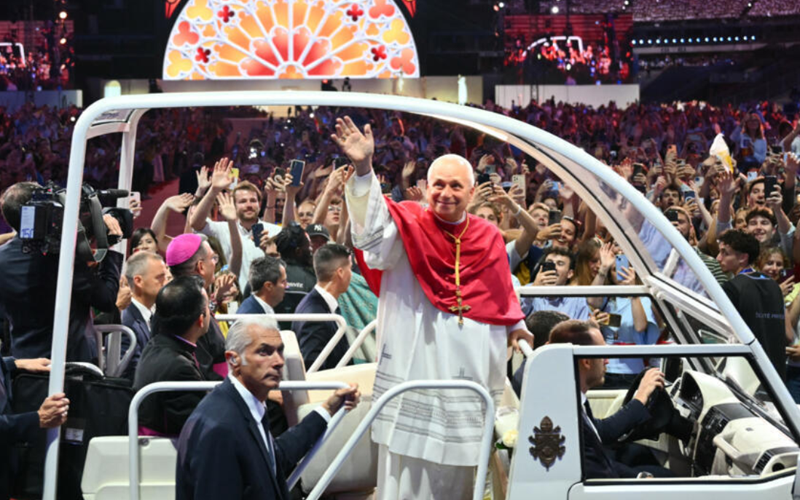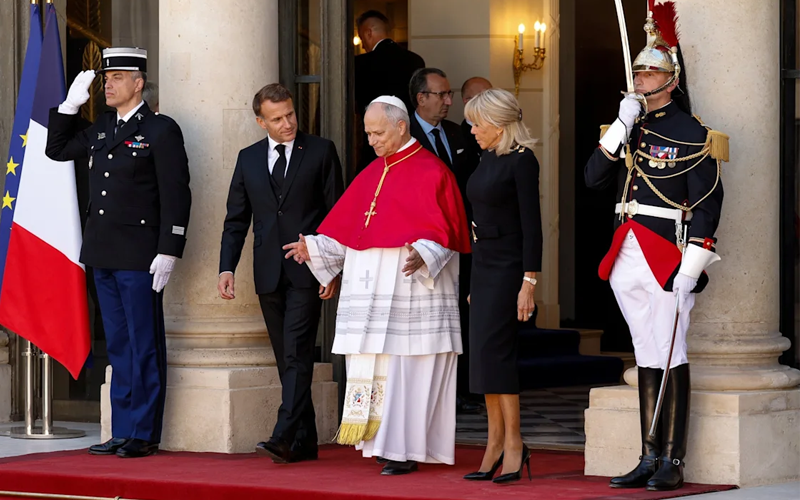
#EU #France – Pope Leo XIV and French President Emmanuel Macron met at the Élysée Palace on Friday, September 25, 2026, at the start of the pontiff’s four-day apostolic journey to France, exchanging formal welcomes and speeches that mixed courtesy with pointed disagreement over secularism and the protection of human life.
Leo XIV, the first American pope, arrived at Paris-Orly Airport earlier that morning and was greeted on the tarmac by Macron and first lady Brigitte Macron. Church bells rang across the country to mark the occasion, the first official papal visit to France in 18 years. The two leaders later convened at the presidential palace, where military honors, an official photograph, an exchange of gifts, a private conversation, and a brief presentation of Macron’s family preceded public remarks in the Salle des Fêtes.
Macron framed the encounter as part of the long-standing relationship between France and the Holy See and emphasized French laïcité as a guarantee of freedom of conscience rather than hostility toward religion. He pointed to the restored Notre-Dame Cathedral as a symbol of national cooperation and said the Republic had a duty to allow believers and nonbelievers alike to speak in public life, provided they respected the law.
The pope answered by quoting Macron’s own words from an April 2018 address to French bishops at the Collège des Bernardins. “A Church that claims to be uninterested in temporal matters would not be fulfilling her vocation; and that a President of the Republic who claims to be uninterested in the Church and in Catholics would be failing in his duty,” Leo XIV said, turning the president’s earlier formulation into a challenge.
He praised the reconstruction of Notre-Dame as a sign that what seemed irreparably destroyed could be reborn through cooperation, thanked Macron for his commitment to the project, and recalled France’s Christian roots from St. Irenaeus and the baptism of Clovis through the Enlightenment. He also noted his own family origins in Normandy and Béarn.
The heart of the pope’s speech, however, was a defense of human dignity. Leo XIV condemned trends that, he said, risked turning science into a profit-driven enterprise through genetic manipulation, surrogacy, organ trafficking, or “the possibility of arranging one’s own death.” He described the recently adopted French assisted-dying law as part of a broader temptation to expect science to eliminate all suffering and insisted that “the protection of the right to life constitutes the indispensable foundation of every other human right.” Authentic secularity, he argued, does not exclude religion from public life or education but values it as a resource for the common good.
The meeting took place against a backdrop of strained protocol. The Vatican had declined Macron’s request for a private tour of Notre-Dame after vespers later that day, citing a packed schedule and a desire to return the cathedral to the faithful. Macron himself did not attend any of the public Masses on the itinerary; Prime Minister Sébastien Lecornu and Brigitte Macron were designated to represent the government at the large outdoor liturgy planned for Place de la Concorde. Reports in the French press had already described friction over bioethics legislation and the optics of pairing a papal visit with policies the Church opposed.
After the Élysée session, Leo XIV proceeded to UNESCO headquarters for an address on artificial intelligence, youth, and peace, then to Notre-Dame for evening prayer. The rest of the visit included a youth vigil, a Mass expected to draw hundreds of thousands in central Paris, stops in Lourdes, and a speech in Metz on Europe’s future.
The encounter illustrated both the formal warmth of Franco-Vatican relations and the limits of that warmth. Macron received the pope as head of state; Leo XIV used the occasion to remind France’s leaders that, in the pope’s view, indifference to the Church and to Catholics would itself be a failure of duty.
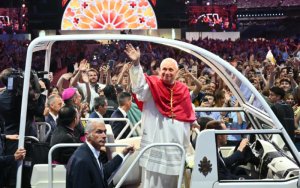
Cover Image: Pope Leo XIV was in Paris on September 25th, 2026, as part of his apostolic journey through France.