#EU #Spain – The Basilica of the Holy Cross at Cuelgamuros is a pontifical basilica under the direct jurisdiction of the Holy See—not the local Archdiocese of Madrid or any Spanish bishop. Since 1958, a community of Benedictine monks has lived there, responsible for worship, prayer for the Civil War dead, and maintaining the site as a place of reconciliation. This unique status has put the Vatican at the center of the ongoing dispute over the Spanish government’s “resignification” project, which aims to transform the monument into a site of “democratic memory” under the 2022 Democratic Memory Law while preserving worship.
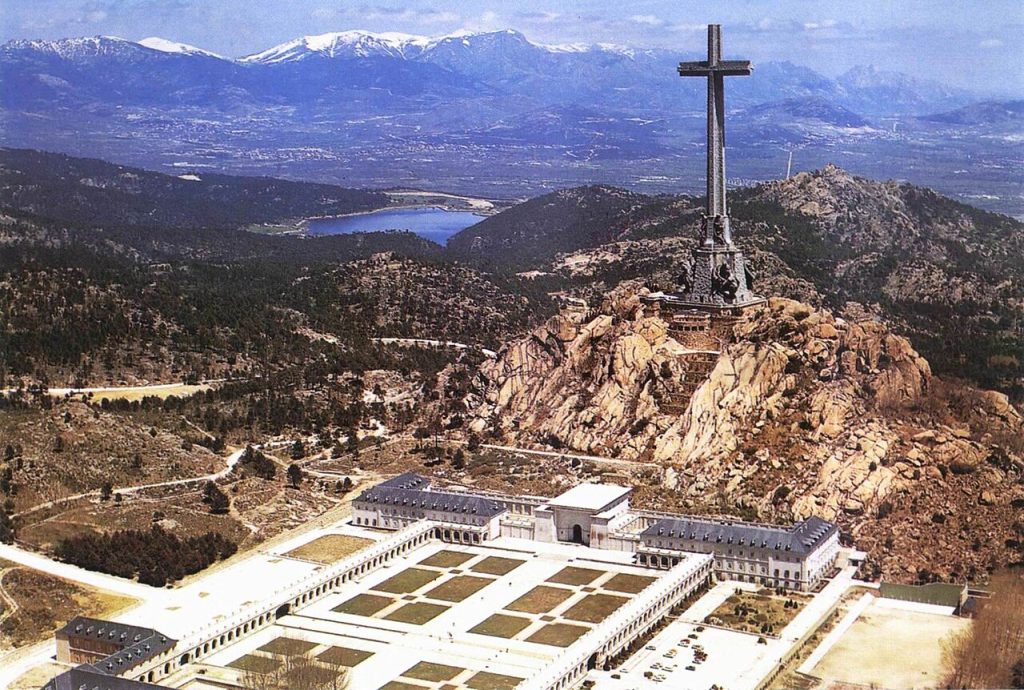
The Valle de los Caídos (Valley of the Fallen), officially renamed Valle de Cuelgamuros (Valley of Cuelgamuros), is a massive post-Civil War era monument in the Sierra de Guadarrama near San Lorenzo de El Escorial approximately 30 miles northwest of Madrid.
The monument was built between 1940 and 1958 as a memorial to the victims of the Spanish Civil War (1936–1939), featuring a huge underground basilica carved into the mountain, a Benedictine abbey, and the world’s tallest Christian cross (~492 feet) atop a granite outcrop. The intention of the monument from the government at the time was a “national act of atonement” and reconciliation. Over 33,000–40,000 people from both sides of the civil war were buried here.
The site is considered controversial by leftists in Spain who see it as a memory of the military dictatorship and bitter loss in the Spanish Civil War. Critics also see it as an archaic Catholic memorial. In 2022, the socialist government in Spain took on an endeavor to redefine the monument to become more inclusive to Spanish society and celebrate liberal democratic values. In November 2025, plans were approved to remodel the memorial to ‘modernize’ the memorial to fit a contemporary Spain.
The Basilica of the Holy Cross at Cuelgamuros is a pontifical basilica under the direct jurisdiction of the Holy See—not the local Archdiocese of Madrid or any Spanish bishop. Since 1958, a community of Benedictine monks has lived there, responsible for worship, prayer for the Civil War dead, and maintaining the site as a place of reconciliation. This unique status has put the Vatican at the center of the ongoing dispute over the Spanish government’s “resignification” project, which aims to transform the monument into a site of “democratic memory” under the 2022 Democratic Memory Law while preserving worship.
In early 2025, the government led by Minister Félix Bolaños held direct talks with the Vatican, particularly with Cardinal Pietro Parolin, the Secretary of State. These negotiations produced a framework agreement: the Benedictines would not be expelled, the basilica would not be desacralized, Catholic worship would continue with independent access, and key religious symbols (including the giant cross) would be respected. The government presented this deal as a balanced compromise that allowed architectural and interpretive changes to the esplanade and surrounding areas while keeping the monks in place. Cardinal José Cobo, Archbishop of Madrid, acted as the Church’s designated interlocutor and signed a related March 2025 framework document with Bolaños. The Spanish Bishops’ Conference gave it unanimous support.
However, the Benedictine community itself was not fully on board. They filed an administrative and legal recourse (appeal) challenging the resignification plans and the validity of the Cobo-Bolaños agreement. Their core argument: only the Holy See has authority over a pontifical basilica and the monastic community entrusted to it. Cardinal Cobo himself has publicly stated that the Archdiocese of Madrid has no canonical jurisdiction over the basilica or the monks—material and architectural decisions rest with Rome. There were reported pressures on the monks from the government and even some Church figures to withdraw their appeal, but they refused.
The Holy See responded with decisive support for the monks comes in. In mid-to-late April 2026, the Holy See formally accepted the Benedictines’ appeal, opening a formal canonical (Church law) process. This move runs parallel to the multiple civil lawsuits already filed in Spanish courts (at least nine in total, including the monks’). By admitting the recourse, the Vatican is signaling that it will now scrutinize claims of “ecclesiastical consent” to the government’s project. It has not publicly endorsed the specific Cobo-Bolaños framework as a Vatican-signed deal—the Spanish Bishops’ Conference explicitly clarified on April 24, 2026, that “the Vatican has not signed any agreement” on the matter, despite Bolaños describing it that way.
The Vatican has not ruled out further intervention if needed. This canonical review could delay or modify key aspects of the resignification such as planned changes to the esplanade, staircase, and interpretation centers, which the government had hoped to advance in June 2026—coinciding with a papal visit to Spain.
This recent news coincided with Pope Leo XIV authorizing decrees recognizing the martyrdom of 49 additional Spanish Catholics killed in Catalonia during the civil war between July and November 1936. This announcement came during an audience with Cardinal Semeraro and coincides with ongoing interest in Spain’s historical memory, including discussions around sites like Valle de Cuelgamuros. Although the Vatican has not signalled outright opposition to the plans of the socialist government, a desire to preserve the memory of the faithful martyrs killed by the Republican faction during the civil war could place the Holy See at odds with the Spanish government as they hope to advance this important cultural project.
Pope Leo XIV is scheduled to make an apostolic visit to Spain from June 6 to 12, 2026. This visit will be the first papal trip to Spain since 2011 when Pope Benedict XVI attended World Youth Day in Madrid. The Vatican officially confirmed the dates in late February 2026, following an invitation from King Felipe VI and the Spanish Church.
Image: Abadía de la Santa Cruz del Valle de los Caídos (Abbey of the Holy Cross of the Valley of the Fallen) in 2009.