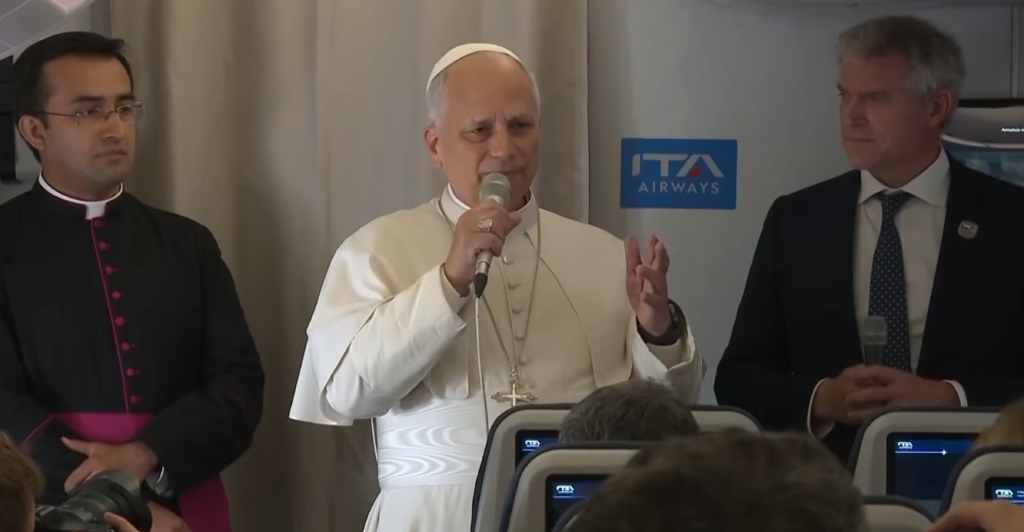
#Vatican – Pope Leo XIV held an in-flight press conference with accompanying journalists on April 23 during his return flight to Rome from Malabo, Equatorial Guinea—the final stop of his 11-day apostolic journey to Africa (covering Algeria, Cameroon, Angola, and Equatorial Guinea). The roughly 20-minute session covered pastoral themes alongside global issues. Pope Leo emphasized that papal trips are primarily pastoral and evangelical—focused on meeting the people of God, proclaiming the Gospel, and sharing in their joys and sufferings—rather than purely political.
Speaking on the regional conflict in the Middle East, Pope Leo XIV strongly advocated a “culture of peace” over violence, noting many innocent deaths (including children) and calling for resumed dialogue and peace efforts between the United States and Iran. He stated, “As a pastor, I cannot be in favor of war” and urged respect for international law, protection of civilians, and efforts to avoid escalation’s economic and humanitarian fallout. He condemned unjust actions, including capital punishment and regime-related violence. Although the question, which came at the end of the press conference, was posed on allegations that Iran was executing prisoners, the answer was an overarching one. The Israeli parliament had most recently passed a death penalty law that would permit the Israeli government to execute Palestinian prisoners of war, which was received with celebrations in the Knesset and by Zionist figures.
On the subject of migration, Pope Leo XIV acknowledged states’ rights to regulate borders but stressed addressing root causes in poorer countries (e.g., resource exploitation in Africa). The pope refuted claims from critics and observers, particularly Republicans in the United States responding to his opposition to mass deportations under the Trump administration, that he was not for open borders as critics claim. However, in line with Church teaching, Pope Leo stressed that migrants must be treated with dignity as human beings and not like animals. Catholic critics of the Trump administrations mass deportation policy have condemned this policy as being contrary to the dignity of the human person for the manner in which they are being held in detention centres, deprived of religious freedom and access to the Eucharist, and seemingly deported in an undignified manner.
In speaking on his relations with authoritarian leaders during his Africa trip, Pope Leo framed those meetings with heads of state as part of the pastoral/diplomatic mission, not endorsement, while encouraging better governance for people’s benefit. He reaffirmed a pastoral duty of outreach to all people, especially political leaders, while not shying from the charitable act of admonishment, as he had done so when addressing authority figures and diplomats before and during his trip.
Lastly, Pope Leo XIV addressed concerns with the Catholic Church in Germany related to the blessings of same-sex unions. He firstly denounced those blessings and stated that the Holy See addressed them with the bishops. He then reaffirmed, in keeping with his predecessor Pope Francis, traditional teachings on marriage and stated that under no circumstances does the Church, or will the Church, ever allow blessings for same-sex unions as marriages. Rather, as what Pope Francis attempted to convey in Fiducia Supplicans was a permission of general blessings being given to any person regardless of who they were or what sins they lived in. Pope Francis openly preached an open-door Church for all peoples to find Christ, but his message was not meant to be interpreted as novel or opposed to traditional Church teaching, nor a permission to bless sin or sinful matters. He also stated that although issues of sexuality are a concern for the Roman Catholic Church, other sin-related issues should take priority for building unity around Christ.
Image: Pope Leo XIV seen speaking to journalists aboard his returning flight to Rome at the end of his Africa apostolic journey.