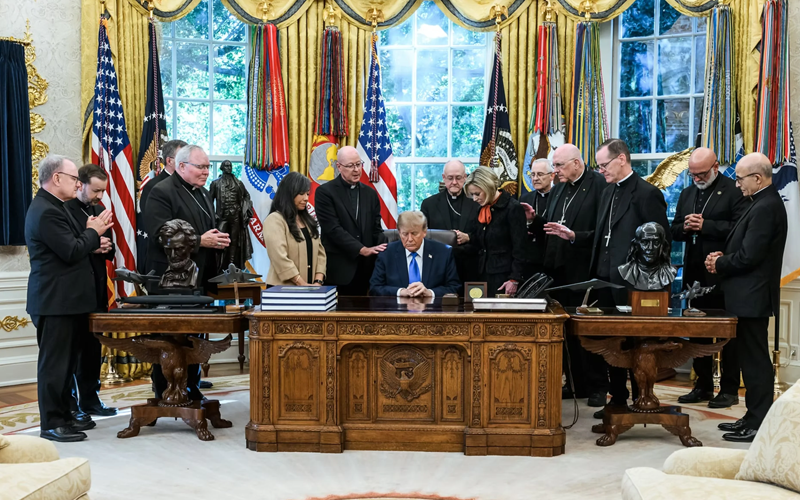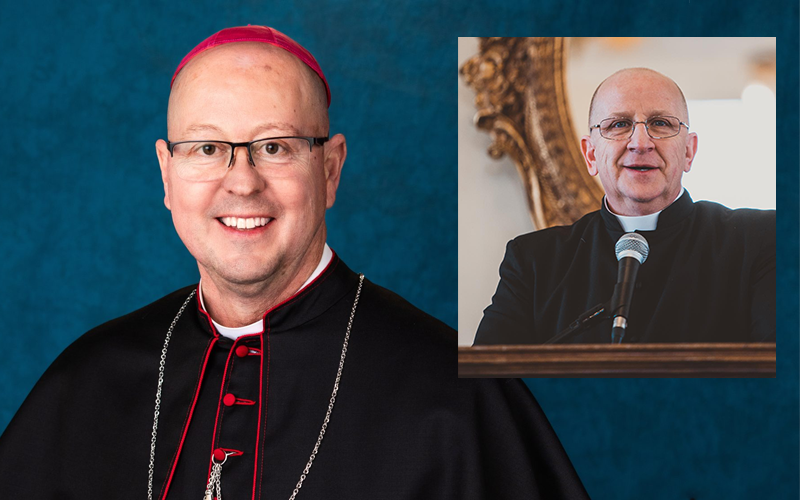
#Accountability – Bishop Robert Barron, Roman Catholic bishop for Winona-Rochester, Minnesota, has drawn scrutiny for his deportment at a White House prayer event on April 1st, 2026, and his failure to respond to controversial statements made during that event.
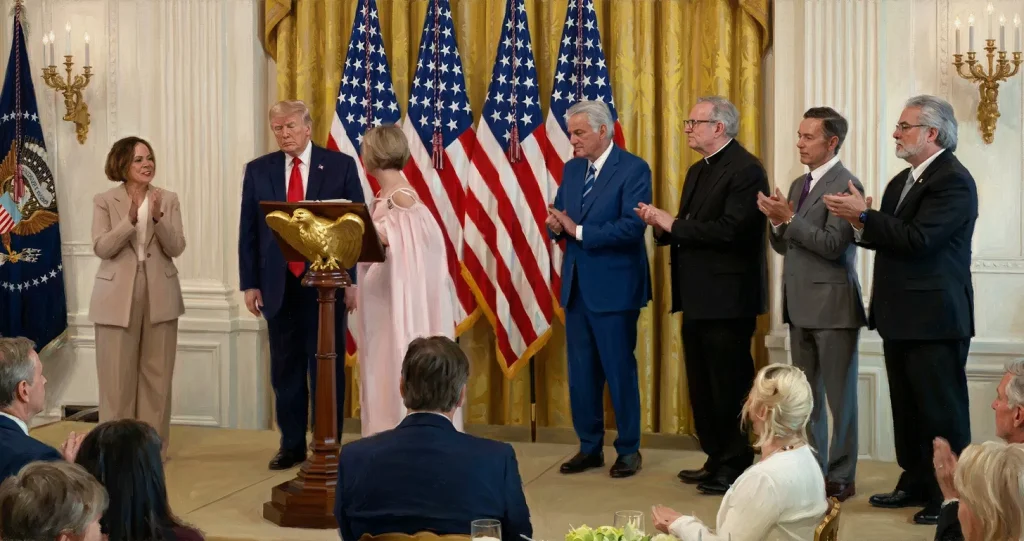
At the event attended by Barron (alongside figures like Paula White-Cain, Trump’s spiritual adviser, and other Christian leaders), White delivered remarks comparing Trump’s experiences—legal battles, assassination attempts, betrayal—to Jesus Christ’s Passion, death, and resurrection. She made comments such as, “No one has paid the price like you have paid the price… You were betrayed… it’s a familiar pattern that our Lord and Savior showed us,” and “Because of His resurrection, you rose up… you were victorious.” Leaked video showed Barron clapping during these comparisons. Critics across Catholic circles called it blasphemous, idolatrous, or tone-deaf during Holy Week. Paula White was most recently subject to controversy in a Holy Week message where she asked followers to donate money to her so she could fund projects in Israel.
Later on during the event, U.S. President Trump, in talking about Jesus’ entry into Jerusalem on Palm Sunday, made a remark that others called Jesus a king during that historical event, and then compared Jesus to himself as others call him a king too. The remark drew criticisms of Trump comparing himself to Jesus, especially amid recent controversies in the past year from his association to Jeffrey Epstein, his support of Zionism, and the overall ongoing Iran War. Bishop Barron, present during these comments, was further accused of his “MAGAfication” and overly close alignment with President Trump. The bishop was also accused of skipping diocesan Holy Week duties in Minnesota to attend a partisan spectacle, in addition to being scrutinized for failing to object or distance himself from a political leader equating himself with Christ.
All sorts of Catholic faithful expressed disappointment on social media and outlets, with accusations of him participating in “blasphemy” and questions about him prioritizing politics over pastoral obligations. Some tied it to broader unease with his role on Trump’s Religious Liberty Commission. In the last month, Bishop Barron was scrutinized for his failure to support Carrie Prejean Boller, a Catholic woman who was removed from the Religious Liberty Commission due to the defence of her beliefs and the incompatibility of Zionism with Catholicism. This incident amplified those existing tensions from that dispute, where Barron criticized her perception from the same commission as “absurd” and blamed Carrie’s behavior at the commission for her removal rather than because she was being persecuted.
In response to these recent criticisms at the White House, Barron later shared the text of his invocation/prayer at the event, focusing on Jesus’ Passion, Resurrection, mercy, and kingship while blessing the nation, troops, and president without endorsing the comparisons. At the same time though, there were no comments opposed to those comparisons, or any other controversial remarks made by others at the prayer event.
The controversy comes also as the bishop recently appeared in an interview with Neo-Conservative political commentator Ben Shapiro in which Barron was asked about the context of Pope Leo XIV’s words in his Palm Sunday address that stated that God does not hear the prayers of those with “blood on their hands,” which was widely believed to be in reference to the Iran War, and more specifically, U.S. government officials responsible for that war. Earlier in March, the Pope made a similar address in which he called for Christian leaders who make the decision to go to war to examine their conscience and go to Confession. Although the bishop correctly clarified that the biblical passage from the Book of Isaiah referred to ‘unjust’ wars, he then attempted to re-interpret the message as not being a reference to the Iran War, but rather that the Pope was speaking generally with no particular reference to any current events or ongoing conflicts. This interpretation drew further negative reactions from Christians that Bishop Barron was reinterpreting the Pope’s words to appease Shapiro and the Pro-Israel Lobby, and further cater to mainstream Neo-Conservative groups rather than prioritize Christian ministry and the Gospel message. Between all these controversial moments, critics have argued the bishop had not behaved ‘Christ-like’ in recent times as he sits with politicians and warmongers not for the purposes of evangelization and a peaceful resolution to current events, but personal gain and political advances.
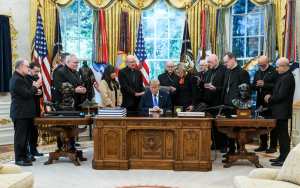
Image: Bishop Barron seen at the White House prayer event on April 1st, 2026, as per the leaked video.