#Serbia – Groups of Serbian Orthodox believers and other residents who gathered Saturday to oppose the city’s Pride march found themselves fenced off, outnumbered by riot police and, in several cases, removed from the streets.
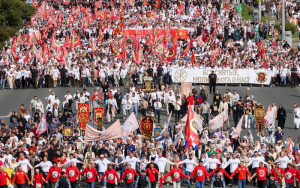
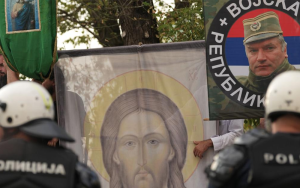
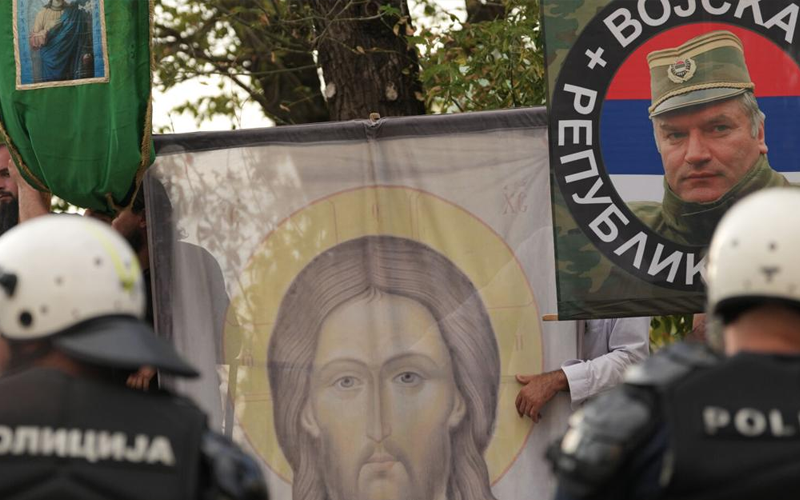
On Sepember 5th, 2026, as the Pride column moved through central Belgrade, a cluster of people assembled at the Church of the Ascension along Kneza Miloša Street. They held icons and lamps, rang church bells and called out in protest. Some displayed imagery of Ratko Mladić, whose memorial service had been held earlier the same day at the House of the Serbian Army. Police formed a barrier between them and the march and prevented any closer approach.
A smaller group led by a priest tried to move toward the procession near the National Assembly. Officers of the intervention police stopped them. The priest was detained; three other people who crossed the cordon were also taken away. Witnesses said the crowd behind the church fence remained there for the duration of the march, shouting across the metal barriers while officers stood between the two sides.
City authorities had closed major streets and erected fencing along the Pride route. Officers in riot gear manned three security rings that organizers and officials said were intended to keep the parade from being disrupted. For those who had come to the church and nearby sidewalks to register their opposition, the effect was that they could not reach the procession or speak to participants face to face.
The gathering at the church occurred on the same afternoon as a commemoration for Mladić attended by his family, retired officers, Serbia’s justice minister and officials from Republika Srpska. Supporters who had come into the city for that event and for the church protest described a day in which expressions of traditional religious and national feeling were kept at a distance from the state-protected march.
Pride organizers used the slogan “There is room for all of us” and linked the march to broader political protests. Counter-demonstrators at the church rejected that framing, arguing that the parade itself left no public space for their views. The right-wing Dveri movement later said it would seek a long-term ban on Pride events, citing what it called the promotion of values incompatible with Serbian family and religious life.
By evening the Pride column had returned to Manjež Park for a concert. The people who had stood at the church fence dispersed after police maintained the separation until the streets reopened. No large-scale street fighting was reported, but the day’s images were of worshipers and opponents held behind cordons while the parade passed under heavy guard.
Cover Image: Counter-Protesters seen being held up behind local police in tactical gear.