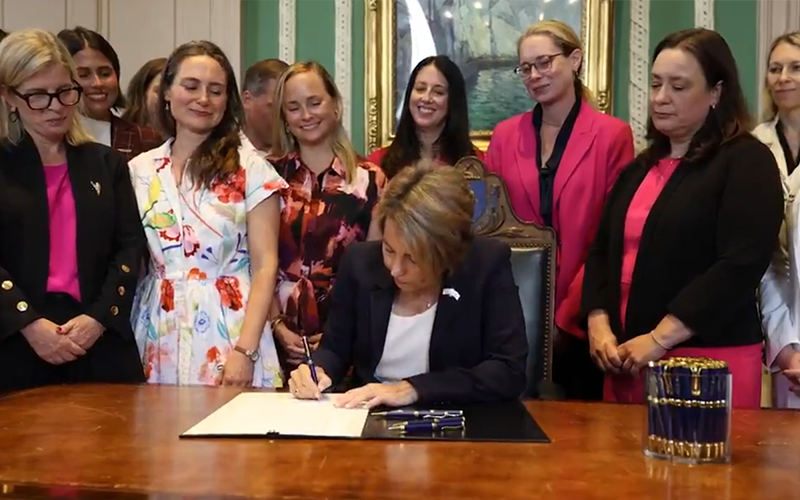
#USA #MA – On Monday, August 10, 2026, Governor Maura Healey signed the Prioritizing Patient Access to Care Act into law, fundamentally reshaping Massachusetts abortion statutes by eliminating the state’s 24-week gestational limit and placing decisions about later-term procedures entirely under the professional judgment of physicians.
The legislation, formally known as H.5595, had cleared the Massachusetts House of Representatives on July 22 by a 119-33 vote and received Senate approval in the closing hours of the formal legislative session later that month. Healey signed the measure during a morning ceremony in her ceremonial State House office, flanked by lawmakers, physicians, advocates, and patients who had shared accounts of personal hardship under the prior rules.
Under the previous law, abortions after 24 weeks of pregnancy were permitted only under narrowly defined exceptions: when necessary to preserve the life or physical or mental health of the pregnant person, or in cases involving a lethal fetal anomaly or grave fetal diagnosis. The new statute struck those restrictions. It stated that an abortion may be performed by a physician based upon the professional judgment of the physician, effective 90 days after signing.
“We’ve heard so many stories — stories that are filled with a lot of pain and anguish and heartache and a lot of trauma,” Healey said at the ceremony. “We heard stories about the worst moments of a person’s life, of a couple’s life. We’re signing this law today so that new patients, people we won’t know or won’t meet, will be able to get the care that they need in Massachusetts.” She added that health care decisions “should be made between women and families and their doctors, not politicians,” and affirmed that “Abortion will remain safe, it will remain legal and it will remain accessible here in Massachusetts.”
Advocates and medical organizations had long contended that the earlier exceptions proved insufficient in practice. Reproductive Equity Now estimated that dozens of Massachusetts patients each year were compelled to travel out of state for care after 24 weeks, often facing substantial financial and emotional burdens. Kate Dineen, who attended the signing with her husband, recounted discovering at 33 weeks in 2021 that her son had suffered a catastrophic stroke in utero. The couple traveled roughly 500 miles to Maryland and paid approximately $10,000 for the procedure because their circumstances did not clearly satisfy the prior statutory criteria.
“Abortion care is health care, and thanks to this new law, pregnant patients in Massachusetts will no longer have to travel far from their home state to access the care they need,” said Carol Rose, executive director of the ACLU of Massachusetts. “At a time when reproductive freedom is under relentless attack across the nation, this new law ensures that our commonwealth remains at the forefront of the movement to protect and expand civil liberties in the United States.”
The Massachusetts Medical Society, the Society for Maternal-Fetal Medicine, and the state’s chapter of the American College of Obstetricians and Gynecologists endorsed the change. Lawmakers and physicians argued that pregnancy complications and fetal diagnoses are often too complex to fit neatly into fixed legal categories. “We’ve decided to get away from all the exceptions and trust our medical professionals, who are the best in the world, to make those decisions with the informed consent of the patient,” Rep. Michael Day said when the House approved the measure.
Opposition came primarily from Republican legislators. Rep. Alyson Sullivan-Almeida described the signing as “a very sad day in the commonwealth of Massachusetts,” contending that the law established a precedent allowing abortion “up until the moment of birth for a healthy, viable baby.”
The measure built upon a series of earlier actions taken after the U.S. Supreme Court overturned Roe v. Wade in June 2022. In the immediate aftermath, Massachusetts enacted a Shield Law protecting providers and patients from out-of-state civil or criminal actions related to abortion and gender-affirming care performed legally within the Commonwealth. In August 2025, Healey signed an updated version of that law—often called Shield Law 2.0—that further restricted the disclosure of sensitive provider data, prohibited state and local authorities from cooperating with certain federal or out-of-state investigations into protected care, expanded coverage to additional categories of health professionals, and allowed certain prescription labels for reproductive medications to list a practice name rather than an individual clinician.
State data released earlier in 2026 illustrated the broader shifts in access. Abortions reported in Massachusetts roughly doubled from 24,355 in 2023 to 49,450 in 2024. Telehealth medication abortions accounted for a large share of the increase, and out-of-state residents made up the majority of patients that year—27,836 compared with 21,407 Massachusetts residents. Groups facilitating the mailing of abortion medication reported serving tens of thousands of patients annually under the protections of the shield laws.
Most abortions in the state continued to occur in the first trimester. Procedures at or after 24 weeks remained uncommon, with 99 reported in 2024. With the new law, Massachusetts joined a limited group of states and the District of Columbia that lack specific gestational limits written into statute.
Healey explicitly linked the signing to the approaching election, declaring that “Abortion is on the ballot in this election. It couldn’t be more clear.” Supporters presented the legislation as further evidence of Massachusetts’ commitment to maintaining broad access to reproductive health care amid divergent state policies nationwide. The law’s sponsors and backers said it prioritized patient needs and clinical expertise over what they described as arbitrary governmental restrictions.
Cover Image: Governor Maura Healey signing the Prioritizing Patient Access to Care Act on August 10th, 2026.