#USA #NY – A federal judge issued a consent order on Thursday, July 30th, 2026, temporarily shielding four orders of Catholic nuns, the Diocese of Rockville Centre, and the Catholic Health System of Long Island from enforcement of New York’s Medical Aid in Dying Act.
U.S. District Judge Anne M. Nardacci of the Northern District of New York entered the order after the state agreed not to compel the plaintiffs to comply with the law while their lawsuit proceeded. The statute, signed by Gov. Kathy Hochul in February 2026, was scheduled to take effect on August 5, 2026. It permitted terminally ill, mentally capable adult residents with a prognosis of six months or less to request and self-administer life-ending medication after confirmation by two physicians and other safeguards.
The plaintiffs included the Carmelite Sisters for the Aged and Infirm, the Dominican Sisters of Hawthorne, the Missionary Sisters of St. Benedict, the Little Sisters of the Poor, Bishop John O. Barres, the Roman Catholic Diocese of Rockville Centre, Catholic Health System of Long Island, and several affiliated nursing homes and assisted-living facilities. Represented by the Becket Fund for Religious Liberty, they filed suit in mid-July in Carmelite Sisters for the Aged and Infirm v. James, naming Attorney General Letitia James and other state officials as defendants.
The groups argued that the Medical Aid in Dying Act, combined with requirements under the existing Palliative Care Information Act, would force them to inform patients about assisted suicide options, assist with eligibility determinations, and refer patients to participating providers. They maintained that those steps violated core Catholic teachings on the sanctity of human life and constituted compelled speech and participation in an act they considered morally forbidden. Noncompliance, they said, risked civil penalties of up to $2,000 per violation, professional discipline, loss of licenses, and potential criminal exposure.
Although the law contained some conscience and opt-out provisions for religious facilities and individual clinicians, the plaintiffs contended the protections were among the narrowest in the nation and left them exposed on counseling, referral, and facilitation requirements. They sought a temporary restraining order and preliminary injunction to prevent enforcement against them.
Under the consent order signed Thursday, New York officials agreed not to enforce the challenged provisions against the named plaintiffs, their medical providers, employees, or clinical contractors while the case continued. The relief was limited to those parties and did not halt the law’s general implementation statewide. A hearing on the motion for a preliminary injunction, previously set for early August, was expected to be rescheduled.
Bishop John O. Barres of the Diocese of Rockville Centre called the agreement “an important first step towards protecting religious freedom.” He stated that New York could not force the Church to answer suffering with suicide and that the temporary protection allowed the ministries to continue serving patients according to the Gospel. Becket president Mark Rienzi described the order as safeguarding the sisters and those they cared for while the groups pursued a permanent end to what they termed a “suicide mandate.”
State officials had previously emphasized that participation in medical aid in dying was voluntary and that religious facilities retained opt-out rights. The consent order did not resolve the underlying constitutional claims, which included free-exercise and free-speech arguments under the First Amendment as well as related federal-law issues. The lawsuit remained pending, with the temporary shield in place as the parties prepared for further proceedings.
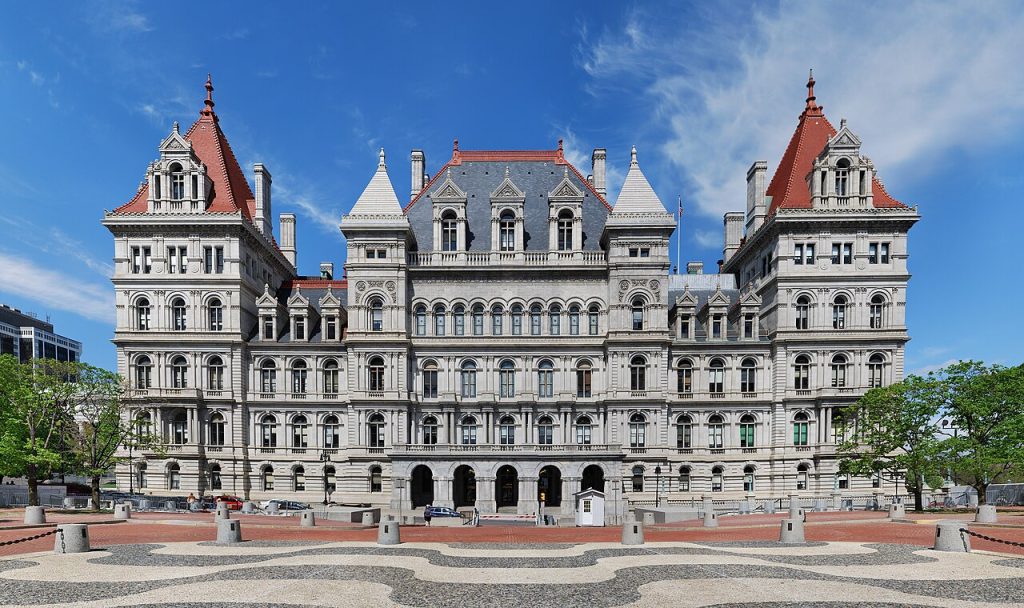
Image: New York State Capitol building in Albany.