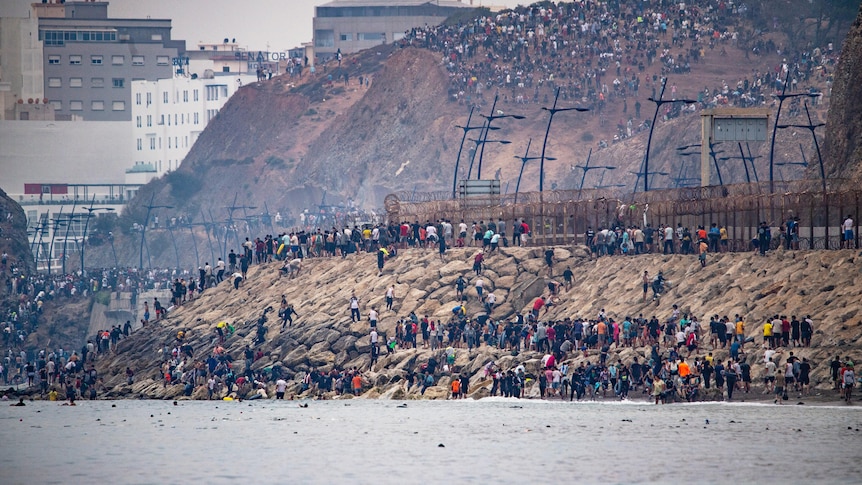
#EU #Spain – Tens of thousands of migrants, predominantly young Moroccan men along with some families, women and children, poured into the Spanish North African exclave of Ceuta from neighboring Morocco on July 30 and into July 31, 2026, in what officials described as the largest such influx in the territory’s history.
Estimates of the total who entered ranged from more than 40,000 to as high as 60,000, according to Spanish Interior Ministry figures and statements from Ceuta’s president, Juan Jesús Vivas. The higher figure represented roughly 70 percent of the city’s usual population of about 83,000 to 85,000. Many crossed by swimming or wading around the El Tarajal (Tarajal) breakwater and border fence, while others entered on foot. The scale far exceeded the 2021 crisis, when more than 8,000 to 10,000 people entered after Morocco temporarily relaxed border controls.
At least several dozen migrants died in the attempt. Reports put the death toll between the high teens to 57, with many drowning in the waters near the border and others killed in a crush or stampede at the breakwater. Spanish authorities recovered multiple bodies on their side of the frontier, and rescue operations continued.
Spanish police and Civil Guard officers were initially overwhelmed, with limited personnel on the front line as the flow at times reached hundreds of people per hour. Migrants filled streets, parks and overwhelmed reception facilities; many slept outdoors. Ceuta’s local government declared a humanitarian and social emergency and appealed for national support.
Spain’s central government responded by deploying additional National Police, Civil Guard units and military personnel, along with air, naval and diving support. Prime Minister Pedro Sánchez traveled to Ceuta on July 31, describing the episode as “a violation of Spain’s territorial integrity.” He blamed trafficking networks for exploiting a recent Spanish Supreme Court ruling that barred the summary return of migrants intercepted at sea while trying to reach Ceuta or Melilla. Sánchez announced plans to install maritime buoys to mark the maritime border more clearly and pledged to accelerate identification and returns.
By Friday evening, Spanish officials reported that large numbers—estimates ranged from more than 37,500 to over 48,000—had voluntarily returned to Morocco. One migrant told reporters the situation inside Ceuta was grim and urged others not to attempt the crossing.
On the Moroccan side, near the town of Fnideq, security forces used water cannons and other measures to push back crowds. Clashes occurred, with some vehicles set on fire. Moroccan authorities urged those who had crossed to return home.
The surge triggered sharp reactions across Europe. Italian Prime Minister Giorgia Meloni warned that uncontrolled immigration threatened European border security and indicated readiness to suspend Schengen free-movement arrangements with Spain. France ordered strengthened controls at its Spanish border and activated rapid-intervention forces. Finland’s interior minister voiced support for tougher measures against countries failing to secure external borders.
The Diocese of Cádiz and Ceuta issued a statement expressing deep concern for the vulnerable people affected. It offered its human and material resources to civil authorities and announced that weekend parish collections in Ceuta would support the diocesan San Antonio migrant assistance center to address urgent needs in coordination with public services. The diocese also called for prayers for those suffering and for those managing the crisis.
Analysts and officials pointed to a combination of factors: social-media videos and rumors circulating after the Supreme Court decision, economic pressures in Morocco, calm summer seas that made swimming more feasible, and questions over the degree of Moroccan border enforcement in the initial hours. Spain and Morocco moved to reinforce the frontier and halt further mass crossings by July 31. Speculation online also pointed at pro-Zionist voices supporting the invasion in the midst of fallout between the United States and Israel with the Spanish government.
Authorities continued managing those remaining in Ceuta while working on returns and longer-term border measures. The events marked one of the most significant tests of the European Union’s only land border with Africa in recent years.
Image: