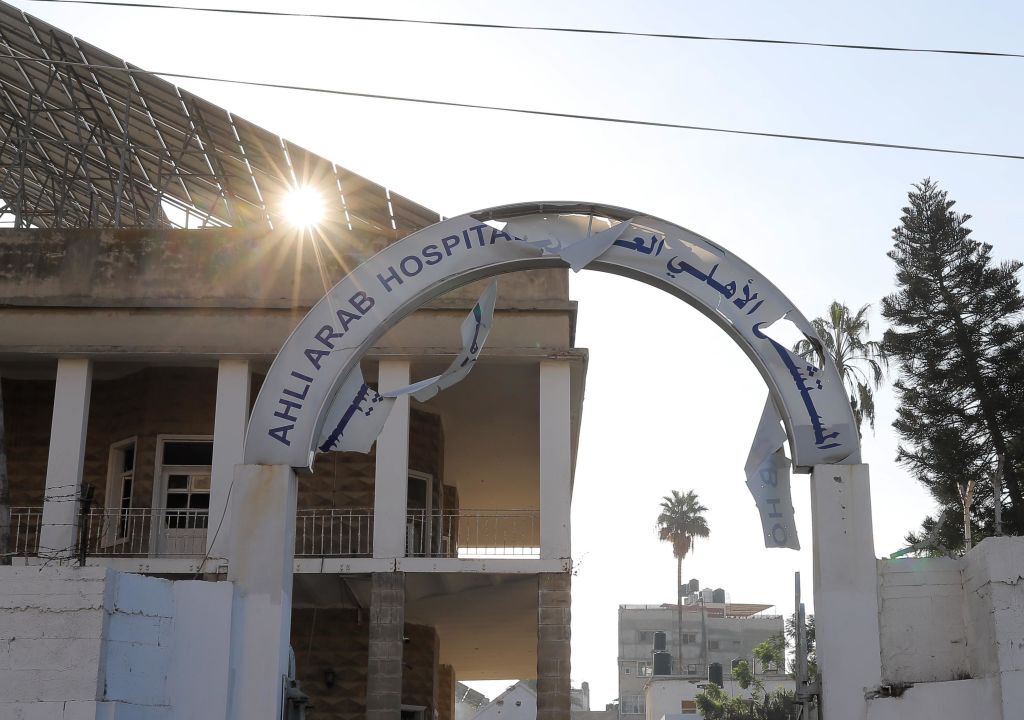
#HolyLand – An Israeli airstrike on a residential apartment building late on July 29, 2026, damaged facilities at the nearby Al-Ahli Arab Hospital, a Christian-run medical center in central Gaza City, according to the Catholic Near East Welfare Association (CNEWA).
The strike did not hit the hospital directly but shattered windows and doors inside the facility and damaged an elevator serving the diagnostic center. Hospital staff reported that the blast caused widespread fear among patients and medical workers. No injuries inside the hospital were reported in initial accounts.
“There was also a significant psychological impact on our medical teams,” said Mousa Ayad, a manager at Al-Ahli Arab Hospital. He noted that the hospital lies less than a mile from the so-called “Yellow Line,” the demarcation of the Israeli-controlled area inside Gaza established after the October 2025 ceasefire. “The repeated explosions create confusion among medical staff and place additional psychological pressure on patients,” Ayad said. He added that while no one could predict the location of future strikes, the hospital’s humanitarian role made it unlikely to be an intentional target.
Mahmoud Basal, spokesman for Gaza’s Civil Defense, said the strike was particularly hazardous because it occurred next to both the functioning hospital and a site sheltering displaced people. Civil Defence crews were unable to approach the location immediately due to fears of a second strike. “The fire burned for more than 15 minutes before our crews could move in,” Basal said. He cited ongoing severe shortages of firefighting vehicles, water tankers, and fuel that complicated emergency responses.
Local emergency officials reported a noticeable increase in attacks on multistory residential buildings around that time. Israeli forces had been issuing broad evacuation orders covering entire residential areas before airstrikes, often without specifying which buildings would be targeted. Basal said this policy forced communities to flee in uncertainty, and high-explosive munitions frequently damaged neighboring structures as well.
According to the Gaza Ministry of Health, nearly 1,200 Palestinians had been killed and about 3,900 injured since the ceasefire took effect in October 2025. Ayad stated that Gaza’s health sector had seen little recovery despite the truce, with hospitals continuing to face shortages of medical supplies, equipment, and essential consumables. Thousands of patients remained on waiting lists for surgery, and many required specialized treatment outside the territory.
Israel had expanded the area under its military control inside Gaza. Reports indicated that Israeli forces controlled roughly 64 percent of the territory by late July 2026, up from about 53 percent at the time of the ceasefire arrangement. Israeli Prime Minister Benjamin Netanyahu had stated intentions to expand control further, to about 70 percent. Satellite imagery analyzed by news organizations showed construction of sand barriers and military positions stretching more than 14 miles inside Gaza along parts of the buffer zone.
Al-Ahli Arab Hospital, supported by CNEWA and operated under the Episcopal Diocese of Jerusalem, had faced previous incidents during the conflict, including damage in earlier years. The July 29 strike underscored the fragile conditions in Gaza’s health system more than nine months into the ceasefire.
Ayad described the lasting effects: “The sound of the explosion brought back memories of the darkest days of the war. Even after more than nine months of the ceasefire, the war’s impact is still present in every part of daily life.”
Image: Al-Ahli Arab Hospital entrance.