#USA #IL – A federal judge in Chicago issued an expanded temporary order this week shielding nearly every Catholic health care institution in Illinois, along with members of major Catholic and Christian medical groups, from the state’s new assisted-suicide law.
U.S. District Judge Franklin U. Valderrama of the Northern District of Illinois entered the stipulated amended temporary restraining order in Mary Keen Kirchoff, M.D., et al. v. Treto after state officials agreed to its terms. The Thomas More Society, which represents the plaintiffs, announced the order on October 8. It replaced a narrower August 21 order that had covered only the original parties.
The order barred the Illinois Department of Financial and Professional Regulation and the Illinois Department of Public Health from enforcing the End-of-Life Options for Terminally Ill Patients Act against the protected providers. Those covered included members of the Illinois Catholic Health Association, whose hospitals, nursing homes, assisted-living centers, and pharmacies accounted for more than 95 percent of Catholic health care institutions in the state. It also covered members of the Catholic Medical Association, the Christian Medical & Dental Associations, the National Association of Catholic Nurses, and the Catholic Psychotherapy Association, as well as the named physicians and institutions and Catholic facilities in the Diocese of Springfield under Bishop Thomas J. Paprocki.
Governor JB Pritzker signed the law in December 2025. It took effect on September 12 and allowed physicians to prescribe lethal medication that a qualified, terminally ill patient would self-administer. Plaintiffs argued that objecting doctors, nurses, and institutions still faced duties to discuss the alleged benefits of the option, refer or transfer patients, avoid speech the state might treat as obstructive misinformation, and complete related records. Refusal, they said, risked fines of up to $10,000 per violation, loss of licensure, and criminal prosecution.
Thomas More Society filed the suit on August 11 on behalf of four Illinois physicians, Bishop Paprocki, and the Lutheran Care Center. An amended complaint filed September 10, two days before the law took effect, added the associations and two more health care professionals. Peter Breen, the group’s executive vice president and head of litigation, said the state had been poised to force doctors, nurses, and Catholic hospitals to choose between conscience and licensure, and that the order lifted that threat for the covered parties while the case continued.
The protection remained temporary. It was set to stay in place until the court ruled on a motion for a preliminary injunction, with briefing tied to a related appeal in the U.S. Court of Appeals for the Seventh Circuit. The statute itself stayed in force for providers outside the protected groups.
In a separate case brought by Becket, the same court had earlier ordered the state not to enforce the law against Cardinal Blase Cupich, the Carmelite Sisters for the Aged and Infirm, the Little Sisters of the Poor, and a small-town pharmacist while that suit proceeded.
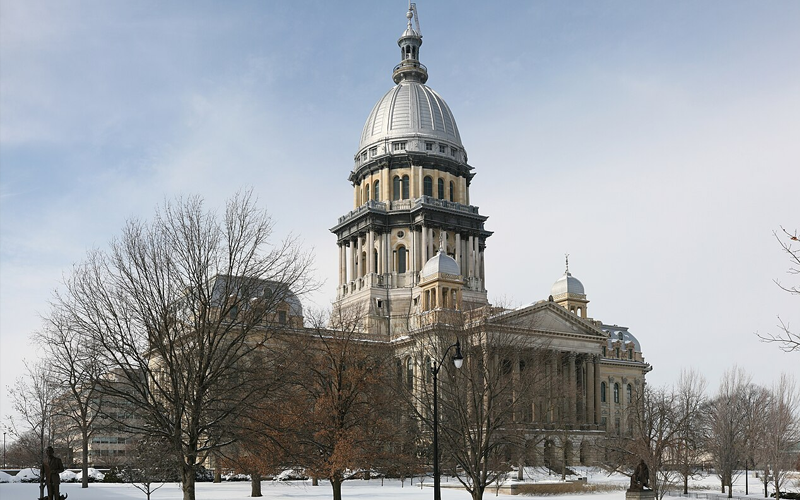
Cover Image: Illinois State Capitol building in Springfield, Illinois.