#USA #MN – Two Christian fathers sued Minnesota this week, arguing that the state’s K-12 education tax subtraction and credit unconstitutionally barred religious instruction and materials while covering other educational expenses.
Nathan Colestock, a pastor and father of four, and Joseph Osburn, a father of six, both of Washington County, filed the lawsuit in Minnesota Tax Court. Attorneys with Alliance Defending Freedom and the Upper Midwest Law Center represented the families against Revenue Commissioner Paul Marquart in his official capacity.
The complaint, Colestock v. Marquart, targeted provisions in Minnesota law that excluded textbooks, instructional materials, fees, and tuition “used in the teaching of religious tenets, doctrines, or worship, the purpose of which is to instill such tenets, doctrines, or worship.” The K-12 Education Subtraction allowed a deduction from taxable income—up to roughly $1,625 per child in grades K–6 and $2,500 in grades 7–12, with no income limit—while the related Education Credit provided a refundable benefit of 75 percent of qualifying expenses up to $1,500 per child for lower-income households. Qualifying costs otherwise included tutoring, textbooks, materials, and enrichment activities such as music lessons.
Colestock and Osburn said they educated their children through Christian curricula, materials, co-ops, and related programs rooted in a biblical worldview. They contended that no subject—reading, arithmetic, science, or history—could be separated from their faith. As a result, they said they had not claimed benefits for which they otherwise qualified, because doing so would have required them to treat their children’s education as non-religious.
The fathers argued that once Minnesota chose to offer the generally available tax benefits, it could not disqualify recipients solely because of religious exercise. The suit claimed violations of the Free Exercise Clause of the First Amendment, the Minnesota Constitution’s guarantee of freedom of conscience, and parents’ rights under the Fourteenth Amendment to direct the upbringing and education of their children. It cited recent U.S. Supreme Court decisions, including Trinity Lutheran Church of Columbia, Inc. v. Comer, Espinoza v. Montana Department of Revenue, and Carson v. Makin, which limited states’ ability to exclude religious recipients from public benefits.
In statements accompanying the filing, attorneys for the families said Minnesota could decide whether to offer educational tax benefits but could not treat families differently simply because they chose to teach their children according to their religious faith. They described the exclusion as forcing parents to choose between their beliefs and a benefit available to other parents.
Minnesota’s education expense provisions traced back decades; an earlier version of a related deduction had been upheld against an Establishment Clause challenge in the 1983 Supreme Court case Mueller v. Allen. The current lawsuit focused on Free Exercise and parental-rights claims rather than Establishment Clause issues. As of the filing, the case remained in its early stages in Tax Court, with no ruling or hearing date reported. The Department of Revenue had not publicly commented on the suit.
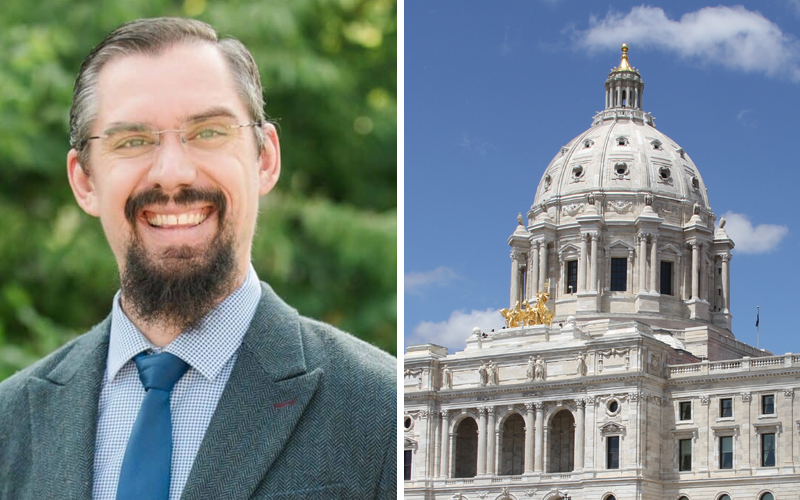
Cover Image: Nathan Colestock (left image taken from Alliance Defending Freedom) / State of Minnesota capitol building in St. Paul (right image taken from Wikipedia Commons)