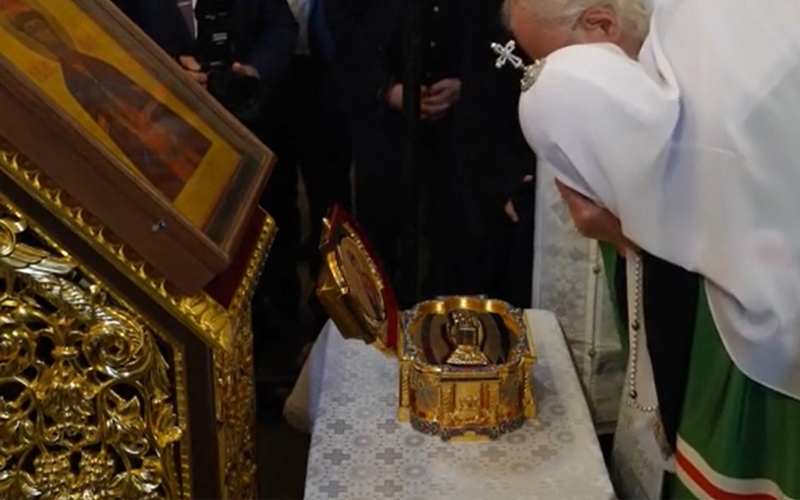
#CIS #Russia – The Russian Orthodox Church announced on August 18th, 2026, that the remains of Holy Right-Believing Grand Prince Dmitry Ivanovich Donskoy had been located and authenticated during restoration work at the Archangel Cathedral in the Moscow Kremlin. The discovery, which occurred in July, marked the first time specialists had opened and examined the warrior-prince’s burial site in modern times.
Restoration teams undertook emergency measures after floor slabs in the cathedral began to subside, threatening the tombstones above the graves of several grand princes. Workers dismantled the brick covers of a crypt near the southern wall and uncovered three intact white-stone sarcophagi. These were identified as the resting places of Dmitry Donskoy, his father Grand Prince Ivan II Ivanovich the Fair (Ivan Krasny), and Prince Dmitry Ivanovich Zhilka of Uglich.
The find resolved long-standing uncertainty. Nineteenth-century engineering work had rearranged the tombs, placing Donskoy’s sarcophagus beneath that of his father to accommodate utility lines; the sarcophagi were later raised to floor level. Kremlin museum curators had therefore lacked definitive confirmation of the precise locations until the 2026 intervention.
Specialists observed two transverse cracks in the lid of Donskoy’s sarcophagus, with the middle section at risk of collapsing inward and potentially damaging the remains. With the blessing of Patriarch Kirill of Moscow and All Russia, the sarcophagus was opened. Archaeologists and anthropologists from the Russian Academy of Sciences then examined the contents.
A combination of historical records, the archaeological context of the burial, and anthropological analysis confirmed the authenticity of the remains. The bones were nearly complete—missing only the left heel bone—showed no signs of postmortem damage, and were well preserved. The examination indicated a man approximately 175–177 cm tall who had sustained a healed injury to the frontal bone and displayed skeletal markers of heavy physical stress consistent with a warrior and ruler. Dmitry Donskoy had died of natural causes in 1389 at about the age of 39.
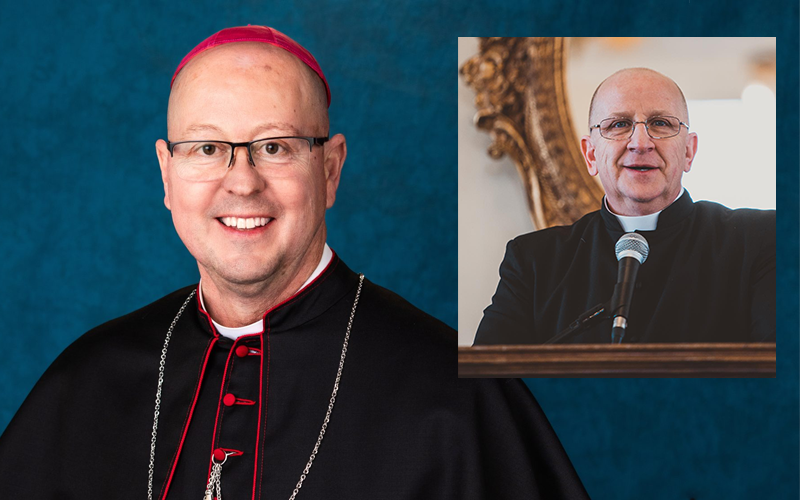
On August 18, Patriarch Kirill led a prayer service before the open relics in the Archangel Cathedral, assisted by Metropolitan Grigory of Voskresensk and the Bishop of Ramenskoye. In his remarks, the patriarch invoked the prince’s intercession for the protection of the Russian land from every enemy and adversary, underscoring Donskoy’s role in the emergence of a sovereign Russian state.
With the patriarch’s blessing, fragments of the relics were set aside for distribution to churches across Russia so that the faithful could venerate them. The bulk of the remains remained at the historic burial site. Presidential aide and historian Vladimir Medinsky described the recovery as nearly fairy-tale-like, unexpected, and highly symbolic.
Dmitry Donskoy (1350–1389) is remembered above all for leading Russian forces to victory over the Golden Horde at the Battle of Kulikovo on the Don River in 1380—the triumph that earned him his epithet. Although Mongol dominance did not end immediately, the battle has long been regarded as a turning point that strengthened Moscow’s position among the Russian principalities and laid foundations for a centralized state. He was the first Grand Prince to bequeath his titles to his son without seeking the Khan’s approval. The Russian Orthodox Church canonized him in 1988.
The Archangel Cathedral has served for centuries as the traditional necropolis of Moscow’s rulers. The 2026 restoration both safeguarded the historic structure and restored public and ecclesiastical access to one of Russia’s most revered national and spiritual figures.
Cover Image: the Holy Relic of Saint Dmitry Donskoy being blessed on August 18th, 2026.