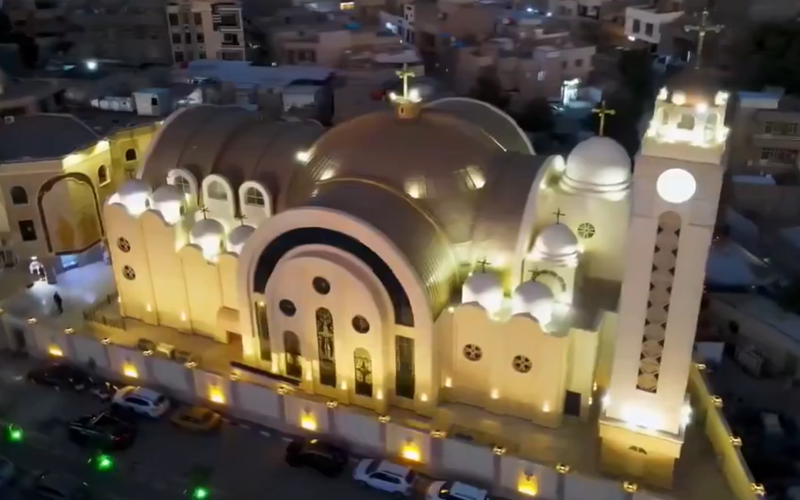
#Iraq #Baghdad – Iraqi officials inaugurated the country’s first Egyptian Coptic Orthodox cathedral on Thursday, November 12, 2026, in the New Baghdad district of the capital, presenting the event as a symbol of religious coexistence and an appeal to Christians who fled years of violence to come home.
Prime Minister Ali Falih Al-Zaidi attended the opening of the Cathedral of the Virgin Mary, St. Paul the Anchorite, and St. Anthony the Great and described the building as a prominent landmark that added to the sanctity of the Land of the Two Rivers. He called religious diversity a blessing for Iraq and its people and a shield against intolerance and division. Karim Hammadi, head of the Iraqi Media Network, told the state news agency that the inauguration demonstrated coexistence and the inclusive nature of Iraqi civilization. He added that the opening sent a clear message to Iraqi Christians abroad that the country was safe and needed them, and that Iraq would remain a protector and “father and big brother” to its Christian communities.
The cathedral belongs to the Coptic Orthodox Church, whose historic roots lie in Egypt, and is the first of its kind in Iraq. Officials noted its symbolic importance for the smaller Coptic community in the country, which consists largely of people of Egyptian origin who arrived in past decades for work in medicine, engineering, and other fields. Clergy present included Anba Antonios, Coptic Orthodox Metropolitan of Jerusalem and the Near East, representing Pope Tawadros II, along with other bishops and priests. The Egyptian ambassador and representatives of other Christian and Muslim communities also attended. Construction began after the foundation stone was laid on November 11, 2012, with support from Iraq’s office for Christian religious endowments and the prime minister’s office; work was delayed for years before completion.
The country’s Christian population declined sharply after the 2003 American invasion. Pre-2003 estimates commonly ranged from about 1 million to 1.5 million. Subsequent sectarian violence, church bombings, kidnappings, and the 2014 ISIS offensive—which emptied large Christian areas in and around Mosul—accelerated the exodus. Recent estimates from church leaders, advocacy groups, and demographers place the remaining population at roughly 150,000 to 250,000, with many now living in the Kurdistan Region or abroad. Officials have periodically called for returns, citing improved security after the defeat of ISIS, though community leaders have continued to cite economic difficulties, incomplete control over armed groups, and other practical barriers.
Cover Image: A still image of the church from aerial view taken from a video produced from the contractor, Almangro Construction and General Trading Company.