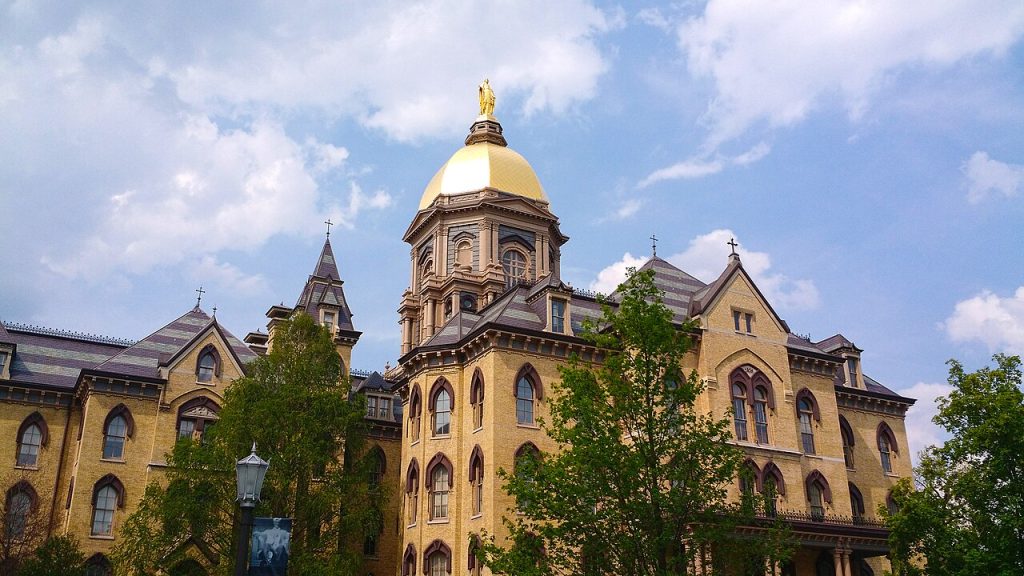
#USA #Indiana – The University of Notre Dame introduced an optional pornography filter on its campus Wi-Fi network in April 2026, drawing mixed reactions from students and critics who viewed the measure as a symbolic gesture rather than a substantive response to long-standing concerns over explicit content.
The development came after nearly a decade of advocacy by student groups seeking a mandatory ban on pornography access via university networks. Conservative student newspaper The Irish Rover reported the rollout on April 14, 2026, noting that students could voluntarily enable the filter to block explicit material.
Student efforts dated back to at least 2018, when the group Students for Child-Oriented Policy (SCOP) gathered nearly 2,500 signatures — including over 1,000 from students — for a campus-wide filter. Then-President Fr. John Jenkins, C.S.C., rejected the proposal, arguing that students should exercise personal responsibility to opt out rather than impose a university-wide restriction. Similar petitions resurfaced in subsequent years, including one in 2025 under current President Fr. Robert A. Dowd, C.S.C., which collected more than 600 student signatures.
Supporters highlighted the prevalence of pornography addiction among students. Notre Dame alumnus Josh Haskell launched a support group during his undergraduate years that initially attracted 35 men; by 2024, it had expanded to more than 150 participants across 30 groups. Administrators faced criticism for not previously offering dedicated resources while opposing network-level restrictions.
Critics, including contributors to The Catholic Herald, argued that the optional filter represented a minimal concession after years of resistance. They contended that the university, as a leading Catholic institution, had failed to uphold doctrinal teachings on the issue and instead prioritized secular considerations, such as student autonomy and concerns over data plans for those with limited mobile access. Opponents of a mandatory filter had previously claimed it would discriminate against such students.
The university’s approach stood in contrast to its own policies prohibiting pornography use on campus networks and to actions taken by other institutions. Commentators noted that Notre Dame had previously navigated controversies over issues like contraception coverage in student health plans and broader cultural debates on campus.
As of mid-May 2026, the filter’s effectiveness remained under scrutiny, with some predicting it would prove easy to bypass and serve more as a public relations step than a meaningful safeguard. The episode underscored ongoing tensions at Notre Dame between student calls for alignment with Catholic values and administrative decisions balancing institutional priorities.